

If your lawn stays soggy days after a normal rain, you do not just have a grass problem. You have a drainage problem that will keep ruining turf, softening soil, and creating muddy low spots until the ground is corrected properly. The good news is that many homeowners can fix lawn drainage issues once they identify where the water is coming from and why it has nowhere to go.
Bad drainage usually shows up in a few familiar ways. Water pools near the house, grass turns thin or yellow in patches, footprints sink into the lawn, and certain areas never seem to dry out. In newer subdivisions, it can also happen after construction when the soil gets compacted by equipment and covered with a thin layer of topsoil that looks fine at first but does not actually drain well.
Why lawn drainage problems keep coming back
Most drainage issues are not caused by one thing. They are usually a mix of grading, compacted soil, low spots, and poor water movement across the property. If you only treat the symptom, like adding seed over a muddy patch, the problem returns because the ground conditions never changed.
Slope is one of the biggest factors. A lawn should guide water away from the house and toward a safe drainage area. If the yard is flat or pitched the wrong way, even a healthy lawn will struggle. Water will sit where it lands, especially during heavy Ontario rain or spring thaw.
Soil composition matters too. Clay-heavy soil holds water longer, and many properties in this region deal with exactly that. Clay is not automatically a problem, but when it is compacted and poorly graded, it becomes one. Water moves slowly through it, roots stay too wet, and sod or seed can fail before it ever gets established.
Start by finding the real source
Before you spend money, take a hard look at the pattern. Is the water collecting in one bowl-shaped area, running off a driveway, spilling from downspouts, or backing up near a fence line? Each of those points to a different fix.
Check the lawn after a rainfall and again 24 hours later. If standing water is still there after a day, the soil and grade are likely part of the issue. If the problem is concentrated near roof edges, downspouts may be dumping too close to the foundation or directly into the yard. If the lawn is wet across a broad area, compaction or poor base preparation could be the bigger problem.
This step matters because the right solution for one property can be the wrong one for another. A simple low spot might need regrading and fresh sod. A yard with runoff from multiple surfaces might need drainage infrastructure as well.
How to fix lawn drainage issues the right way
The best fix depends on the severity of the problem, but most lasting solutions fall into three categories: correcting slope, improving the soil, and giving water a better path out.
Regrading low or uneven areas
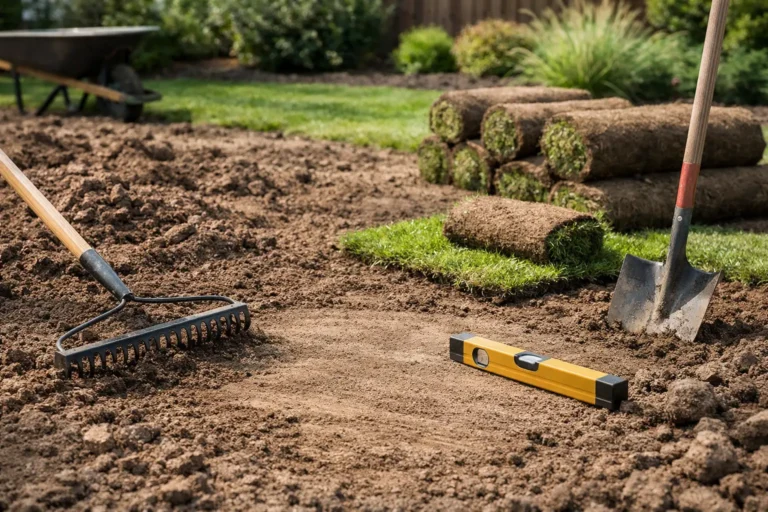
If water sits in visible dips, regrading is often the most effective answer. This means reshaping the lawn so water moves consistently instead of collecting in pockets. It is not about making the yard perfectly flat. It is about creating controlled fall in the right direction.
Minor low spots can sometimes be built up with quality soil. Larger drainage issues usually need more involved grading work, especially if the entire yard pitches incorrectly or the problem area is tied to the foundation. In those cases, surface-level patching rarely lasts.
This is also where many lawn replacements go right or wrong. Putting new sod over bad grading gives you a fast cosmetic improvement, but not a durable one. If the base is still wrong, the sod will struggle once the first few storms hit.
Breaking up compacted soil
Compaction is common on properties that have seen construction, heavy foot traffic, or repeated mowing when the ground is wet. Water cannot move through tight, dense soil very well, and roots cannot establish properly either.
Core aeration can help when compaction is moderate, especially if the lawn is otherwise in decent shape. It opens pathways for air, water, and nutrients. But if the lawn has severe drainage problems or construction-grade compaction, aeration alone may not be enough. Sometimes the better route is removing poor material, improving the soil profile, and rebuilding the lawn properly.
That extra step costs more upfront, but it often saves money compared with repeatedly trying to repair a lawn that never had a workable base.
Extending downspouts and managing runoff
A lot of wet lawn problems start above the ground. If roof water empties right beside the house, the lawn can only absorb so much before it turns into a swamp. Extending downspouts away from the home can make an immediate difference.
The same goes for runoff from hard surfaces like driveways, patios, and walkways. Water follows the easiest path. If those surfaces direct water into one part of the yard, that section may need a swale, catch basin, or grading adjustment to redirect flow more evenly.
Installing drains when grading alone will not solve it
Some yards need more than reshaping. If the property is naturally low, boxed in by neighboring grades, or holding water with no practical outlet, drainage systems may be necessary. French drains, catch basins, and channel drains can all play a role depending on the site conditions.
This is where homeowners sometimes overspend on the wrong system. A drain is not magic if the surrounding grade and soil are still working against it. Good drainage design starts with the lot as a whole, not just the wettest patch.
When sod replacement makes sense
If the lawn is already damaged by standing water, thin grass, mud, and root rot, a full lawn replacement can be the cleaner solution. But it only makes sense after the drainage issue is addressed. Otherwise, you are installing a premium finish over a failed foundation.
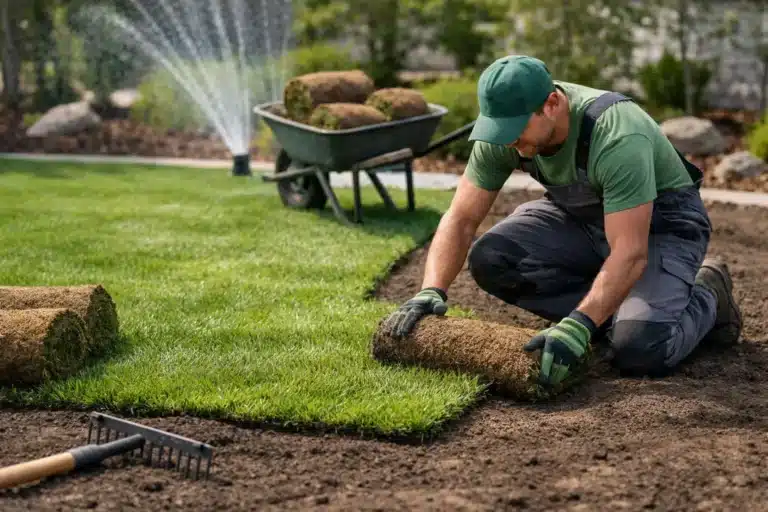
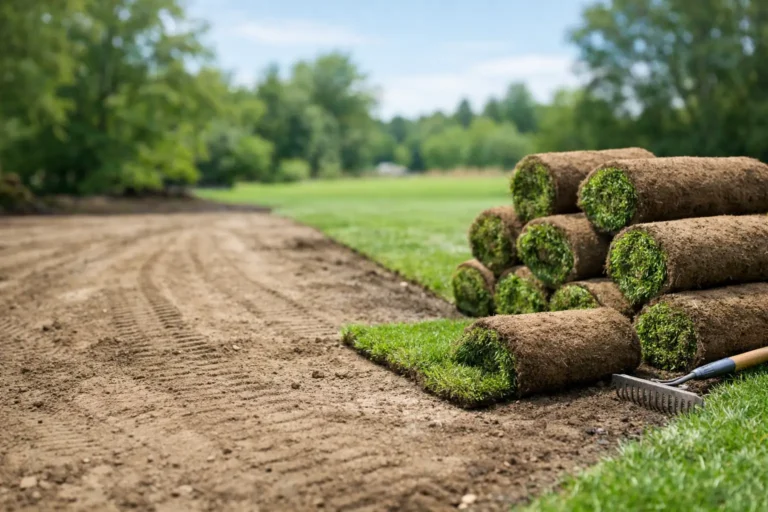
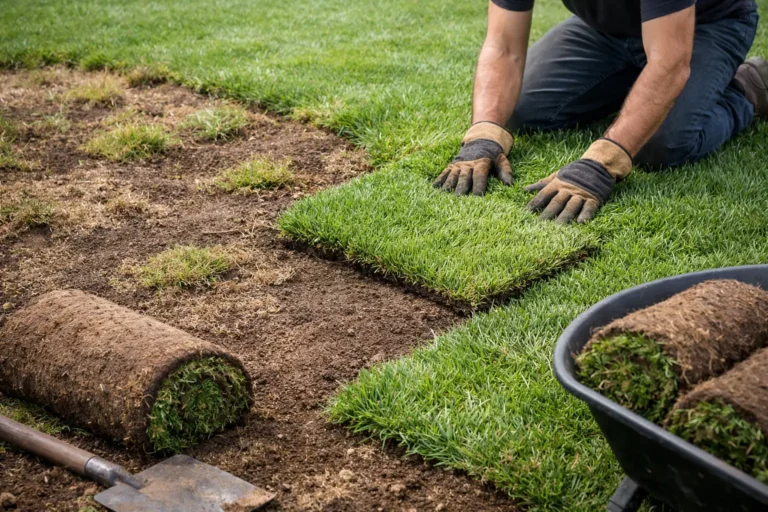
A proper rebuild usually includes removing the old lawn where needed, correcting grade, improving the soil, and laying fresh sod on a prepared base. That approach gives you immediate curb appeal, but more importantly, it gives the new lawn a real chance to root and drain the way it should.
For homeowners who want fast results, this is often the point where working with a sod specialist pays off. Grading, soil prep, and drainage awareness are what separate a lawn that looks good for two weeks from one that establishes properly.
Mistakes that make drainage worse
One of the biggest mistakes is adding topsoil on top of a wet area without fixing the grade underneath. That can temporarily hide the dip, but if the surrounding yard still drains into it, the problem comes back.
Another common issue is overwatering an already stressed lawn. Homeowners see yellowing grass and assume it needs more water, when the roots are actually suffocating from too much. Poor drainage and overwatering can look a lot like drought stress from a distance.
It is also easy to underestimate how much nearby work affects drainage. A new patio, fence line, garden bed, or shed can alter water flow enough to create a new problem area. If the issue appeared after a project, that project may be part of the answer.
What works best in Ontario conditions
In places like Kitchener, Waterloo, and Cambridge, drainage work has to account for more than just summer rain. Spring thaw, freeze-thaw cycles, and clay-heavy soil all put extra pressure on grading and soil prep. What looks acceptable in dry weather can fail quickly when the ground is saturated.
That is why quick fixes have limits here. A lawn may need deeper correction to handle seasonal moisture changes, not just one heavy storm. If the property has repeated drainage trouble year after year, it is usually a sign that the base conditions need professional attention.
Know when to bring in help
If the wet area is small and clearly caused by a simple low spot or short downspout, you may be able to fix it yourself. But if water is sitting near the foundation, the lawn stays muddy across large sections, or previous repairs have failed, it is worth getting an expert assessment.
A good drainage plan should be straightforward. You should understand what is causing the issue, what needs to be corrected, and what kind of result to expect. That is the standard Right On Sod works from when drainage and lawn replacement overlap – practical recommendations, honest scope, and a finished lawn built on proper preparation.
A better lawn starts below the surface. Once the ground drains the way it should, everything above it gets easier to maintain, healthier to look at, and a lot more reliable through the next season.
11 Comments